|
So the Bell which first called together the loyal Assembly of the English Province of Pennsylvania, August 27, 1753, had been cast by
Americans and was destined to "proclaim Liberty throughout the land" twenty-five years after it was ordered with that prophetic inscription.
Yet it began very soon to be the Liberty Bell . When England sent word to the colonies just what laws to make the Bell was rung to show that
the Provincial Assembly "would not make laws by direction." This was in May, 1755. On February 3, 1757, the Bell rang when "Mr.
Franklin" was sent " home to England " to see if something could be done to induce the English Government to show a little regard for the
rights of the American Colonies. On September 9, 1765, the Bell called the Assembly together to arrange for a Congress of all the Colonies
. Less than a month later, on October 5, the Bell was "muffled and tolled" when the British ship, the "Royal Charlotte," arrived in Philadelphia
with the hated stamps provided by the English Government in accordance with the Stamp Act which so roused the indignation of the
American Colonies. The stamps were not permitted to be unloaded, but were sent back to England on a British man-of-war.
Nearly four weeks later, on October 31, the Bell was muffled and tolled all day long when the enforcing of the unjust Stamp Law was begun in America.
Some of the people spent that day in their houses "mourning the death of Liberty," while others indignantly burned hateful stamped papers in a Philadelphia
restaurant known as the London Coffee House. The Bell called the people together on April 25, 1768, to protest against the Acts of Parliament which were
intended to stop planing mills and other lumber mills and to put an end to the manufacture of iron and steel in Pennsylvania. The king had ordered
his arrow affixed to pine trees, claiming them as his own. This probably led to the adoption of the pine tree as an emblem of Liberty on
colonial flags, sometimes with the rattlesnake coiled about its trunk, and oftener with "An Appeal to Heaven "lettered above or below the
pine tree, which was sometimes called the 'Liberty Tree.'"
On July 30, the same year, the Bell called together a meeting of the people in the State House yard to make the statement that "the Parliament
of Great Britain has reduced men here to the level of slaves." December 27, 1773, shortly after the Boston "Tea Party," the Bell called together the largest and most indignant mass meeting ever seen
up to that time about the State House. The ship " Polly " was then coming up the Delaware river loaded with taxed tea and other things from
England. The angry people voted then and there not to permit the "Polly" to land her cargo. They appointed a committee to send the
captain and the consignee with the tea from the Arch Street wharf, where it was about to land, back to its "old Rotterdam place in Leadenhall
Street, London." Not content with sending a committee, the citizens generally went down to see that the tea was not unloaded, having
said in the mass meeting that they would not have "the detestable tea funneled down their throats with Parliament's duty mixed with it," and
that "no power on earth had the right to tax them without their consent."
After the "Indians" had thrown overboard the tea in Boston harbor, the English Goverment closed the port of Boston. So
the Bell was muffled and tolled again when this was announced, on June 1, 1774, and on the 18th of the same month it called a meeting to express the people's sympathy with the Boston sufferers. The Friends, or Quakers ,
of Philadelphia, who did not believe in war, subscribed $ 12,700 in gold, and other people contributed $ 10,000 more, besides eleven hundred and
sixty barrels of flour, and collected from the Southern States one hundred hogsheads of sugar and one thousand barrels of rice, all of which
did much to save the shut- off city of Boston from starving as the British Government intended.
On April 25, 1775, six days after the battle of Lexington and Concord, the Bell called together a great meeting at which
eight thousand citizens pledged themselves to the cause of Liberty. As the discussions of the Continental Congress which adopted the Declaration
of Independence had been held in secret sessions, the Bell did not ring for Liberty until the Declaration was formally read on July 8, 1776.
On July 4, 1777, the Bell rang in the first anniversary of the Declaration of Independence. announced the surrender
of Cornwallis in October, 1781, and welcomed General and Mrs. Washington to Philadelphia during the month following that great victory. In 1783, the Bell
1781, and rang again to proclaim the signing of the treaty of peace which had been signed by Dr. Benjamin Franklin, John Adams and Arthur Lee at
Paris . This treaty formally ended the war. In December, 1799, the Bell tolled during the funeral solemnities in memory of Washington. In 1824 the Bell
welcomed Lafayette to the city.
On the Fourth of July, 1826, the Bell rang joyously to commemorate the "year of jubilee" mentioned in the verse of Leviticus from which
the motto of the Bell was taken. It was fifty years that day from the signing of the Declaration of Independence. On that day Jefferson,
who wrote the Declaration, and John Adams a prime mover of it, died in their homes in Virginia and Massachusetts. The Bell tolled in honor
of those two great patriots and Presidents, on July 24, 1826. On July 21, 1834, the Bell tolled in memory of Lafayette,
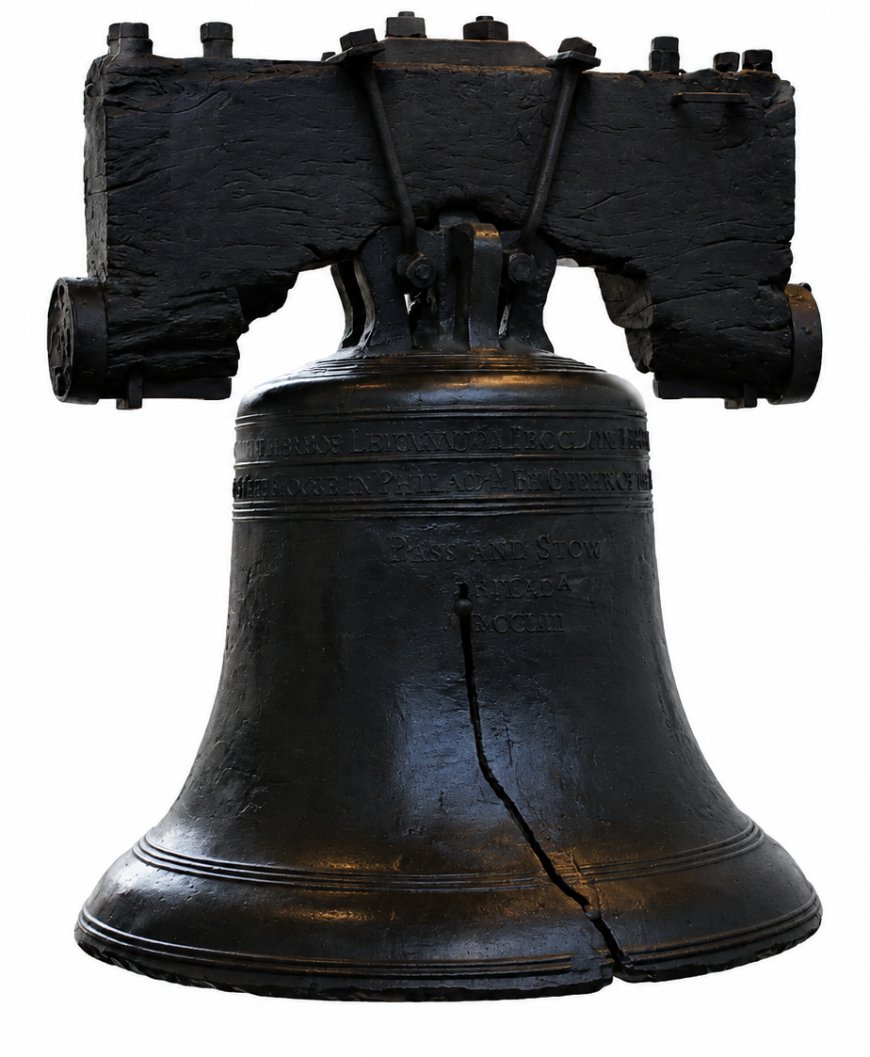
who had recently passed away in his native France. It is claimed by some that the Bell was cracked while tolling for this great French patriot and
friend of freedom. Others say that it cracked while being violently rung as a fire alarm; but authorities generally agree that its voice was heard for the last
time during the funeral of Chief Justice John Marshall, on July 8, 1835. Marshall was the last of the giants and friends of the heroes of the Revolution.
It seemed right and proper that the Bell should be silent now that the voices of those who labored long and
well in the holy cause of Liberty were heard no more in Independence Hall.
|