
Return to Home Page
Special Features
What Did Our Train Depots Look Like?
The 1873 H.&T.C. Depot
The 1873 H.&T.C. Depot at Richardson, Texas, an AI-generated image based on information currently available.
From The Story of Miss Belle's Place: Along with Some Glimpse into the History of Richardson, Texas (Poor Scholar Publications, 2026).jpg)
On April 19, 1873, The Dallas Weekly Herald, a newspaper that no longer exists, published a letter dated April 14, 1873, from a correspondent who called himself (or herself?) "Richardson," posting it from "Richardson, Dallas County, Texas." Among other things, the letter said this: "Richardson is soon to be a depot on the H.&T.C. R.R., near old Breckenridge, in this county."
So far as it is known, this was the first time ever that the name "Richardson" was applied to the place, and specifically to the train depot that the Houston & Texas Central Railway was then building at that place, in the literal middle of what is now called the original town of Richardson, or as I prefer to call it, "Historic Downtown Richardson," or the "Historic Heart," even if neither of those terms are its official appelation.
What did that depot look like?
Over the past several years, I have tried to find out, so far without success. Why? Because unfortunately, there is no known picture or photograph of that 1873 depot. If one does exist, it has not yet come to light.
Nor, apparently, is there any plan or blue-print of the depot.
All we have is a map, drawn by railroad surveyor Theodore Kosse in 1873 (and again in 1878), which shows the position and approximate size and shape of the depot and the platform upon which it sat. (See map below.)
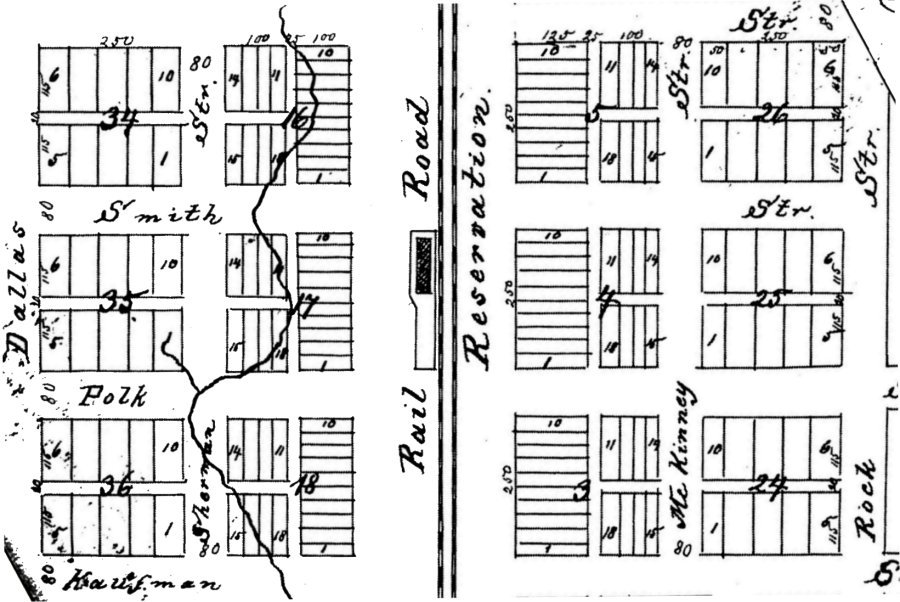
Map of the "Historic Heart of Richardson, Texas
As it happens, we can tell a lot from that map or plan. First of all, we can see very clearly that the depot stood on the west side of a "Railroad Reservation," between Smith Street (now Main-Belt Line) on the north and Polk Street on the south. A careful examination of that map shows that Kosse indicated the dimensions of the blocks and lots into which he divided the city. Each block measured 250 feet square. with the lots in Blocks 17 and 4, on either side of the depot, measuring 25 feet in width by 125 feet in length.
If Kosse drew the map accurately, we can then see that the Railroad Reservation itself was 300 feet wide. We can also see, using those same measurements as our guide, that the platform upon which the depot (the dark rectangle) sat was 250 feet long, stretching from Smith Street to Polk Street.
What about the depot?
Using those same measurements as a guide, it appears that the depot was as wide as a city lot--namely 25 feet--and a little short of the length of a lot, apparently about 100 feet, with the platform on which the depot sat being about 50 feet wide at the north end and about 25 feet wide at the south end. Those figures, it should be noted, are approximations based on the size, shape and measurements of city blocks and lots as seen on this map. The exact measurements may have been slightly more or less, but by and large, they give us some idea the size of the depot and platform.
Unfortunately, those measurements cannot tell us how high the depot was, or anything about its general appearance.
But here's the thing: During the same period that the Houston & Texas Central Railway was laying tracks across North Texas toward Denison, it was building depots not just at Richardson but several other places, some of which previously existed and some of which were brand new, like Richardson. It is reasonable to assume therefore, that in those brand new places, the same type or style of depot was constructed. Unforunately, we don't know this for a fact, in light of a lack of evidence, but logic dictates that conclusion.
So, what were those other brand-new places?
During the Northern Expansion period (1870-1873), there were twelve places that did not previously exist. They were (from south to north): Groesbeck, Mexia, Thornton, Wortham, Ennis, Palmer, Hutchins, Richardson, Allen, Anna, Van Alstyne, and Howe.
Next question: Is the original depot in any of those places other than Richardson still standing more than 150 years later?
Answer: There's only one, in Anna, Texas, which was built in the mid-1880s, not the 1870s.
Second Question: Are there any photographs or pictures of the depots that aren't still standing?
Answer: Yes, there are some. Unfortunately, they show a variety of buildings, not all of which are the original 1870s-era depots. Some (perhaps all) are probably either later buildings or altered original structures. Consequently, they are not helpful in determining precisely what the 1873 Richardson depot looked like. On the other hand, they can give us a general idea. One of these is the old depot museum at Anna, Texas, which was also on the H.&T.C. line to Denison, a little more than 30 miles north of Richardson.
Here are some photos of the Anna, Texas H.&T.C. Depot, taken on Saturday, August 8, 2026. Built in 1885, it is the oldest train depot still standing in the whole state of Texas. It is open on the second and fourth Saturday of each month from 10 a.m. to 2 p.m. When I visited, the volunteers that man the museum inside were very friendly and helpful.
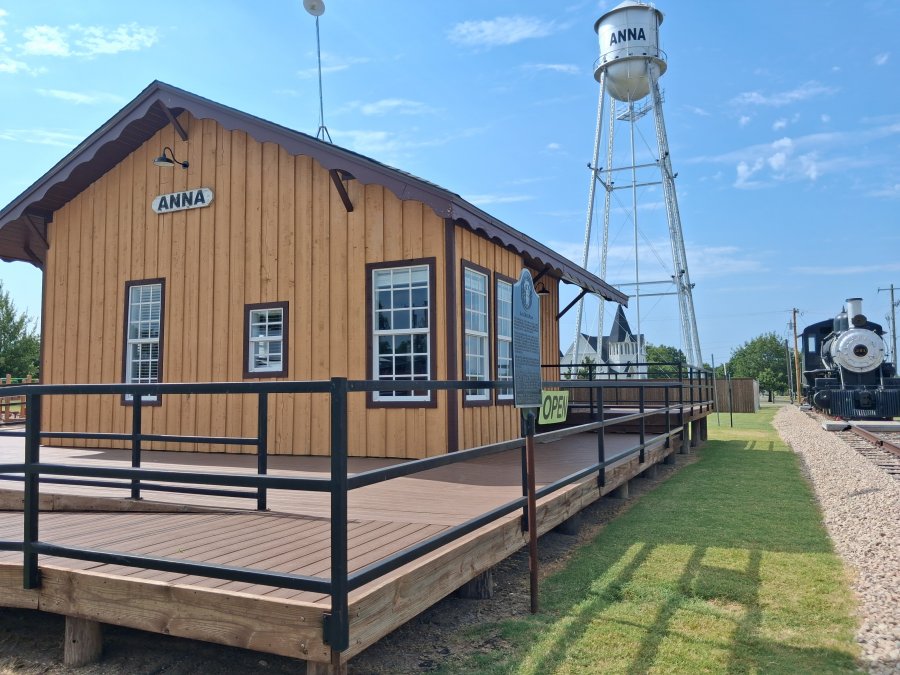
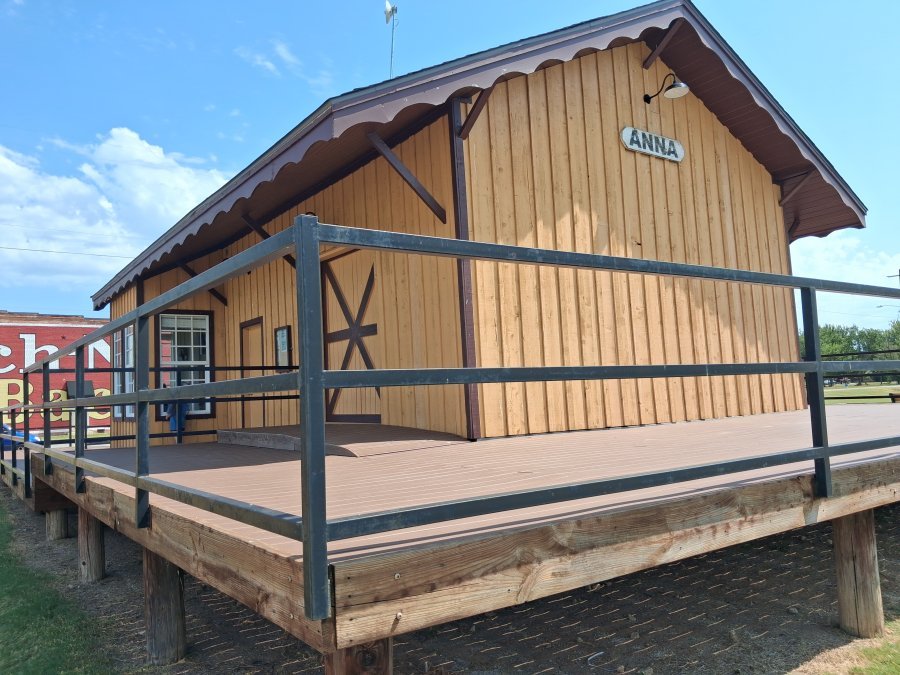
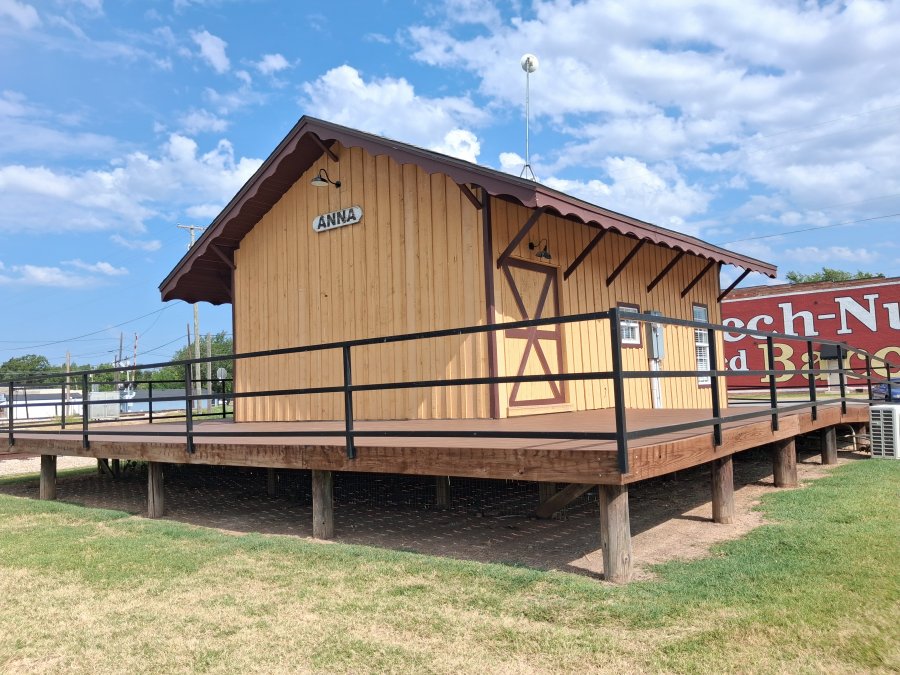
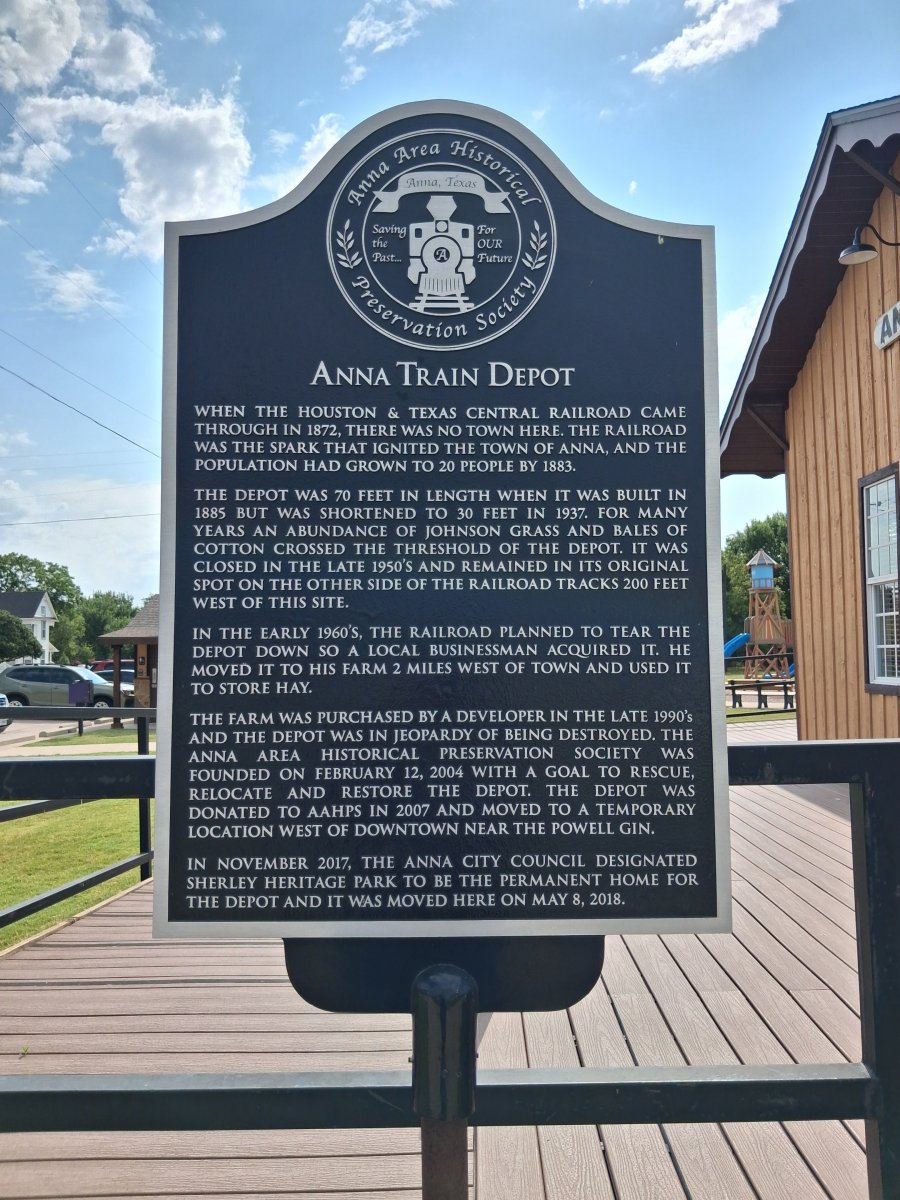
So, is this what the 1873 Richardson depot looked like? Could be.
CONTINUE TO THE 1907 Depot
This website copyright © 2021-2026 (except where noted) by Steven Butler, Ph.D. All rights reserved.
