|
The Miles Family By Steven R. Butler
The Miles Family A Brief Biography of
My paternal grandfather, Charles W. Miles, was born on August 18, 1885 in Franklin County, Tennessee. He was the only known child of John W. Miles and his third wife, Margaret Elizabeth Hodge Miles. In December 1885, when Charlie was only four months old, his father, John W. Miles, abandoned him and his mother, and ran away to Alabama with Mary Alice Hefner, a woman with whom he had been consorting during his marriage to his second wife, Kate, and also during his marriage to Charlie's mother, Margaret. When John W. Miles left, without giving a reason or any warning, he had already fathered three children with Mary Alice, including one that was born in September 1885, just a month after Charlie. In Alabama, J.W. and Mary Alice had two more children before moving to Texas in 1893, where they settled first in Collin County, and then Hunt County. They also had four more children, for a total of nine. Whether or not Charlie ever met any of them is unknown. In 1892, Charlie's mother was granted a divorce from her absent husband. Soon after, in 1893, she married Seaborn E. Jones, by whom she already had two daughters, Daisy and Nettie. Margaret and her second husband, S. E. Jones, are listed in the 1900 federal census for Franklin County, Tennessee, with five children in the household. For some inexplicable reason, Margaret's eldest son, Charlie Miles, is listed in the same census as the "adopted son" of Benjamin W. Rhoton, Jr. and his wife Laura Farris Rhoton. The nature of the Rhotons' relationship to Charlie Miles, if any, is unknown, but it should be noted that when John W. Miles married Margaret E. Hodge in 1884, his fellow bondsman was John T. Farris, brother of Laura Farris Rhoton and brother-in-law of Benjamin W. Rhoton, so clearly the two families had ties of friendship, if not family ties.
Sometime between 1900 and 1908, Charlie Miles left Franklin County, Tennessee and went to live in Dallas County, Texas. How he made the journey, and when, and his reason for doing so are all unknown, but I speculate that he came to Texas because he was offered a job in the general store that Benjamin W. Rhoton's brother, Junius Tribble Rhoton, was then operating in the little community of Audelia, located three miles south of Richardson, Texas, at the present-day intersection of Forest Lane and Audelia Road. Until 1900, Rhoton was also Audelia's postmaster. Charlie may have also been encouraged to settle in Dallas County by the fact that two of his stepbrothers, Charlie T. Jones and Jesse H. Jones were then farming in the vicinity of the town of Garland, Texas, not far from both Richardson and Audelia. Sometime after he arrived in Texas, Charlie Miles somehow became acquainted with Lillian Jane Dalton, daughter of James Franklin Dalton, a farmer who lived near the tiny community of Vickery, located a few miles south of Richardson. On September 27, 1908, Charlie and Lillian were married by the Reverend George Truett, pastor of the First Baptist Church in Dallas. A report of the wedding in the Dallas Morning News remarked that the newlyweds would be making their home in Richardson. The precise location of their rented home has been lost to history, but Richardson was a very small place then, and it was almost certainly somewhere within two or three blocks of the intersection of present-day Main Street/Belt Line Road and Greenville Avenue.
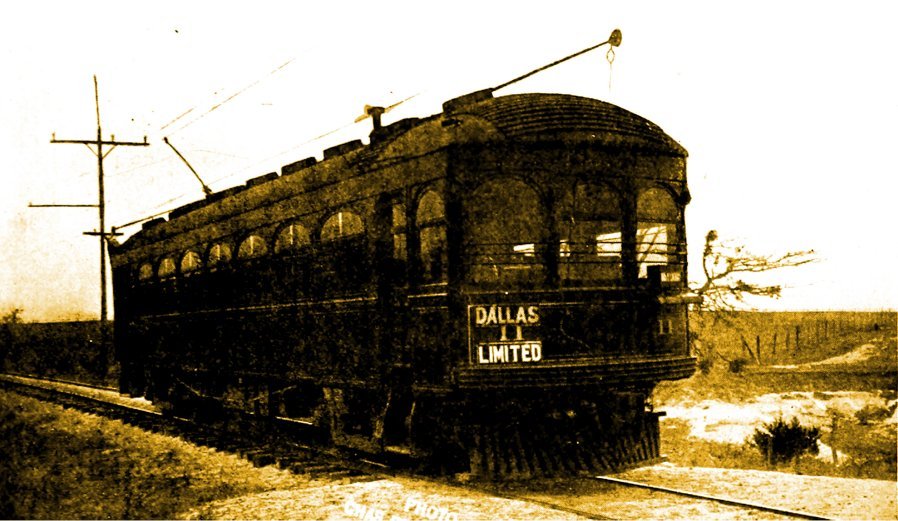
Whether or not Charlie ever knew his father was living only about 30 miles or so north, in Collin and Hunt counties, until John W. Miles' death in 1928, is unknown. During the first two decades of the twentieth century, which included the dozen or so years that Charlie lived in Richardson, some important developments occurred in the community. In 1901, the Richardson Telephone Company began service and on October 12, 1901, the first issue of Sam Harben's newspaper, The Richardson Echo, was published. In 1905, the Citizens State Bank opened for business at present-day 111 East Main Street (then known as Smith Street). In April that same year, there was some momentary excitement when President Theodore Roosevelt passed through town on his special presidential train, "The Rocket." Stopping briefly at the depot, the Houston & Texas Central Railway had built on the west side of the tracks in 1873, "T.R." or "Teddy" as he was popularly known, gave a short speech before "The Rocket" sped on south to Dallas, where the President was met by a much larger crowd and then, following a much longer speech than the one he'd given in Richardson, feted at a banquet at the Oriental Hotel. But that's not all. In 1907, the Houston & Texas Central tore down the old depot which had been built in 1873, and then constructed a new one on the east side of the tracks, north of Smith Street, opposite the dry goods store run by Thompson and Son. The following year, the Texas Traction Company built an electric Interurban line from Dallas to Denison, with Richardson as one of the stops. In 1909, they erected a small brick depot across the street from where the original H.&T.C. depot had stood. A few years later, the Texas Traction Company was bought out by the Texas Electric Railway, which continued to operate the Interurban line until December 31, 1948. CHARLE MILES, LIVERY STABLE OPERATOR
Interestingly, Fred Clint Farrell and Charlie Miles were contemporaries, with Fred being born in July 1885 and Charlie in August that same year. But their experience of life was different. Unlike Charlie, whose father abandoned him at the age of four months and then ran off to Texas to become a cash-strapped farmer in Collin County, Fred's father, James P. Farrell, a blacksmith by trade, though probably not a wealthy man, by 1893 had means enough to be able to buy lots 2, 3, and 4 in Block 16 in the town of Richardson, which both photographs and early maps show was the location of the so-called "onion dock" that was built much later on the site. (see Dallas County, Texas Deed Book 272, pp.474-5). A map that was printed in the one and only issue of The Richardson Recorder (a publication of the Richardson Historical Society) in 1982 shows the town's livery stable located on the northwest corner of present-day W. Main Street and Interurban Street, which corresponds not only to the location given in The Richardson Echo report, but also to Lot 1, Block 16 of the original town plat, as drawn by Houston & Texas Central Railway surveyor Theodore Kosse in 1873 and again in 1878. Dallas County deed records also verify The Echo report, because Lot 1, Block 16 was the property in which Fred Farrell bought a half-interest from G.B. Strait in January 1908. (See Dallas County Deed Book 569, p.615.) Interestingly, the other half-interest in that lot already belonged to Fred's sister, Birdie Farrell, who had purchased it from Strait on December 31, 1892. (See Dallas County Deed Book 633, pp.313-14.) Unfortunately, we do not know what use Strait made of the property. Was he operating a livery stable on the site already? Possibly. In the May 8, 1896 issue of The Dallas Morning News, there is a news item reporting that on October 23, 1894, a bay pony mare, "branded C on the left shoulder," was stolen from G. B. Strait of Richardson and that anyone with information about it should contact either Strait or Dallas County Sheriff Ben E. Cabell. Unfortunately, the two-paragraph-long obituary of "Uncle Ben Strait," published in The Dallas Morning News on May 7, 1916, says nothing about how he made a living, and all other references to him in earlier issues are largely in connection with his activities in fraternal societies or the Sterling Price Camp of the United Confederate Veterans. In the 1950 retrospective piece, The Echo said further that as "automobiles began to take [over] the country," Fred Farrell sold his livery stable to Luther Terry and John Robinson, who in turn sold out to the Texas Electric Railway, and indeed, there is a classified ad in an October 1909 issue of The Dallas Morning News that partly backs up that report. In that ad, Farrell was trying to sell some livestock as a result of having sold his livery stable. But the ad doesn't say to whom he sold it or precisely when. The trouble is that there doesn't seem to be any record of his sale of the property to Terry and Robinson, or to anyone else for that matter, in Dallas County deed books. I have made a thorough search for such a sale and can't find it. But in any event, he could not have sold any but a half-interest in the business because his sister, Birdie, was still in possession of her half-interest when Fred purchased it from her in February 1914, not long after she got married and became Mrs. Birdie Kerr. (See Dallas County Deed Book 643, p.639.) So, does that mean he did not sell the livery stable after all, despite what the newspaper ad said? It would certainly seem so, but deed records do show that after buying his sister's half, he sold all of Lot 1. Block 16 to Mrs. E. T. Drygould, on or about January 2, 1915. (See Dallas County Deed Book 644, p.343.) Deed records also show that in turn, on April 5, 1915, Mrs. Drygould, joined by her husband sold all, not just half, of Lot 1, Block 16 to Luther Terry, with no mention of John Robinson. (See Dallas County Deed Book 643, p.670.) Dallas County deed records also show that on December 4, 1915, Luther Terry and his wife--again with no mention of John Robinson--sold all, not just a half interest, of Lot 1, Block 16, to William Guion, not the Texas Electric Interurban company. (See Dallas County, Texas Deed Book 661, pp.524-5.) What about that onion dock referenced by The Echo? From all appearances, it wasn't built before June 25, 1928, when the Texas Electric Railway bought lots 2, 3, and 4 in Block 16 from the Texas Cotton Oil Company, Lot 1, Block 16 from the Citizens State Bank, and Lots 5-10, Block 16, from W. C. Watson and his wife. This meant the Interurban company then owned the entire eastern half of Block 16. (See Dallas County Deed Book 1498, pp.140-1 & 149.) What all this also means is that in keeping with many similar instances, someone made mistakes or conflated facts when attempting to make a record of Richardson's history. They are still doing it today! But do any of these sales and re-sales of the Livery Stable have anything to go with Charlie Miles? The answer is that the only effect that there would be on Charlie is in terms of whether he got to keep his job. All we know for sure is that the 1910 census for Richardson shows him with the occupation "farm laborer" rather than livery stable keeper or manager, so obviously he didn't keep his livery stable job. Whether than was his decision or someone else's is unknown. Maps that show the location of the livery stable Recently, I came into possession of digital copies of H.&T.C. Survey Maps for 1907 and 1908/9 which show Fred Farrell's Livery Stable right there at the corner of Smith Street (now Main/Belt Line) and Central Street (now Interurban), just a few feet west of the 1873 train depot that we now know was built on the north side of Smith (now Main/Belt Line).
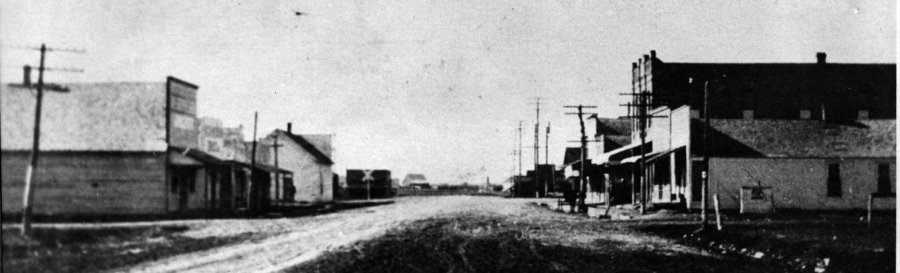
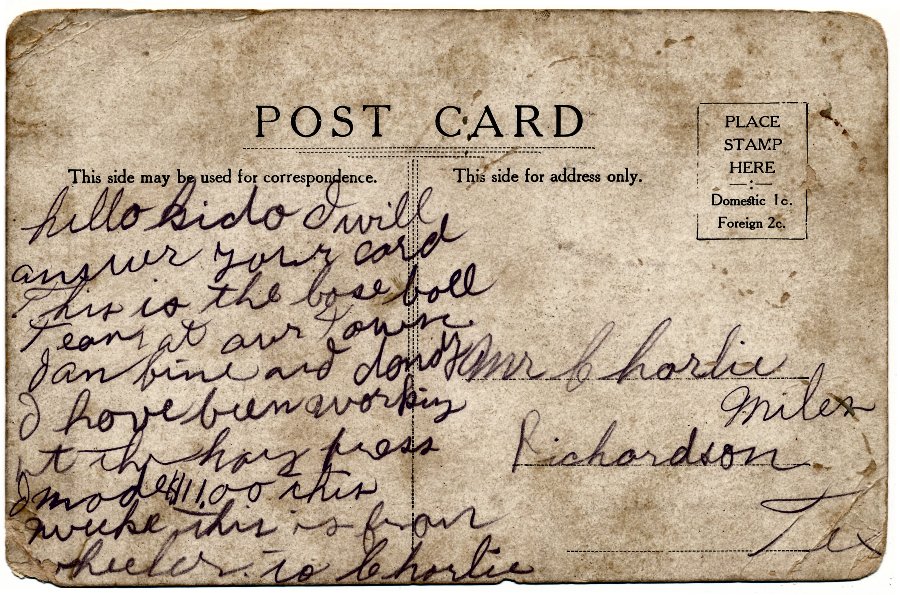
THE MILES FAMILY IN RICHARDSON The 1910 federal census for Justice Precinct 2 of Dallas County, Texas shows that Charlie Miles, his wife Lillian, and their one-year-old daughter Willie Mae, who was born in Richardson on August 1, 1909, lived in rented a house in Richardson. Their nearest neighbors included members of the Blewitt and Huffhines families, both of which were prominent in Richardson at the time. Future Richardson Mayor Kit C. Floyd also lived nearby. The 1910 census shows that Charlie's occupation was "farm laborer," although it's not known who employed him. On July 6, 1911, Charlie and Lillian's second child, Lorene Marguerite Miles, was born in Richardson. When their third and last child (and only son), Roderick Vernon Wesley Miles, was born in Richardson on March 18, 1913, Charlie's occupation was given on the birth certificate as "road laborer." Although automobiles had been manufactured and sold in the United States since the mid-1890s, it was not until prices began to go down in the second decade of the twentieth century that automobile sales correspondingly increased. This growth in automobile ownership led to a subsequent demand for good roads, and in Dallas County, Texas, Charlie Miles was there at the very beginning of a road-building boom that continued unabated throughout the first half of the twentieth century. In the meantime, Richardson continued to grow and change in a number of small ways. In 1911, for instance, the Harben brothers and their father, Dr. Raymond Harben, had a one-story brick building constructed to replace the wood frame building which had housed Harben's Drugstore, a Smith Street (now East Main) establishment, since 1901, and in 1912-1913, electricity became available after an enterprising entrepreneur named G. I. Wilcox, built a power plant in town. Indoor plumbing would have to wait, however, until 1926. Until then, citizens had to make do with wells that sometimes ran dry, and outhouses. Bathing was usually a once-a-week event and if you didn't have your own tub, you could take a bath in the back of Newt Harris's barber shop on Smith Street, directly across from the Citizens State Bank and Harben's Drugstore, which were almost certainly familiar sights to members of the Miles family. During the decade or more that Charlie Miles and his family resided in Richardson, Texas, some remarkable things were happening there. Although the town didn't look like much (see photo below), it was expanding in both land size and population as town lots in new additions became available, although apparently Charlie wasn't making enough money to buy any property. In all likelihood, Charlie and his family lived only a short walk from Smith Street (now East Main) where all the stores were located. They almost certainly shopped at McKamy and Reddick's grocery store, or Jess and Oliver Harben's grocery store, and also at Sam Harben's drugstore. For a cool glass of lemonade or a Coca Cola they would have stopped by Brack Lotheridge's refreshment stand. If Charlie had a bank account it would almost certaialy have been with the new Citizen's State Bank and it's near certainty that when he had his haircut, barber Newt Harris took care of it. We know that Charlie subscribed to the local newspaper, The Richardson Echo. In those days there were no house numbers and mail had to be picked up from Mrs. Allen's post office on Central Street (now Texas Street). Whenever anyone wrote to Charlie, like his half-brother Wheeler Jones, who lived in Fort Cobb, Oklahoma, he simply addressed it: "Charlie Miles, Richardson, Texas."
In 1908, Richardson became a stop on the Texas Traction Company's Interurban line, making travel to Dallas more frequent and cheaper than by train. Residents could also travel on the Interurban as far north as Dension.
THE MILES FAMILY IN EAST DALLAS Although Richardson was growing, sometime between the birth of Roderick in 1913 and Charlie's registration with the draft board on September 18, 1918, the Miles family decided to leave. For a short time, they lived in or near the rural community of Vickery, located near the present-day intersection of Greenville Avenue and Walnut Hill Lane, where Charlie's in-laws, the Daltons, resided. On his draft registration card, Charlie not only included his middle name, Wesley, in his signature, but also gave his occupation as "Road Supervisor" rather than "laborer." The following year, the Miles family moved to East Dallas, where they rented a house at 1426 Rowan Avenue. In 1920, a carpenter/contractor named Herman H. Butler, his wife Alice, and their three children-Henry, Margaret, and Ruth-purchased the house next door, at 1428 (later renumbered 1432) Rowan Avenue.
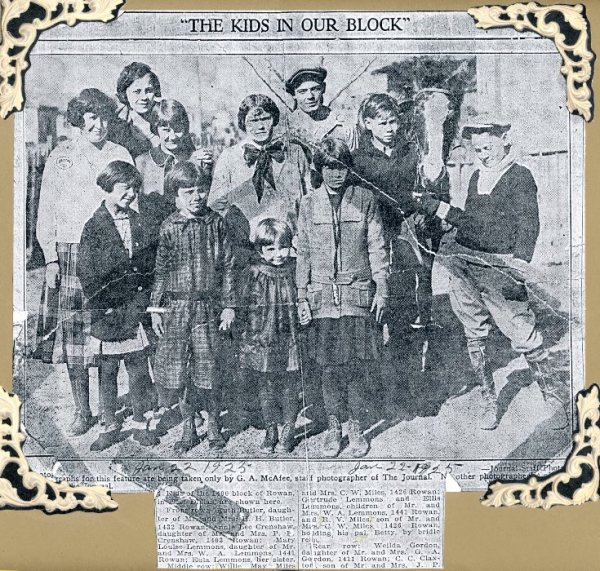
Because they were all nearly the same age, and lived next door to one another, it seems only natural that the Miles children and the Butler children would become playmates, a fact that is confirmed by a 1925 feature article in the Dallas Journal, which included a photo of some of the Rowan Avenue neighborhood children, in which they are identified by name and address. In the photo, ten-year-old Ruth Butler is seen standing directly in front of slightly-older Willie Mae Miles. Roderick Miles, holding a horse by the bridle, is also seen in the photo.
THE MILES MOVE THAT NEVER WAS In 1911, Dallas businessman Col. Frank P. Holland bought some land midway between Dallas and Fort Worth, on the Interurban line and T&P railway line between those cities and then began to develop it and sell lots in what he called "Dalworth Park." In 1928, while the Miles family was still living at 1426 Rowan Avenue, Charlie and Lillian paid $225 for Lot No. 4 in Block 159 of this Dalworth Park development, obviously with a view to building a house on the site and moving there. (See Dallas County, Texas Deed Book 1471, pp.214-6.) But for some unknown reason, they never did. Instead, in 1929, they moved to another rent house in East Dallas, and then another, and then another and so on, until 1945, when they bought a property in northwest Dallas and built a modest house on that particular lot instead. In the meantime, they held on to the Dalworth Park property, year-after-year-after-year, right up until September 11, 1952, when they finally sold it for "ten dollars ($10.00) and other valuable considerations" to a man named F. E. Hoggatt. (See Dallas County, Texas Deed Book 3729, p.465.) Why they held on to that property for such a long time (twenty-four years) without apparently doing anything with it is a mystery. In 1942, Dalworth Park was annexed by the City of Grand Prairie, Texas. Unfortunately, the official plat map of Dalworth Park only shows blocks numbered from 1 to 150, then skips to 201, so it is impossible to know exactly where the Miles property was located, but in all likelihood, based on the unnumbered portions of the map, their lot was located somewhere immediately south of present-day I-30 and John Adams Middle School, in the vicinity of a conventional shopping center on Carrier Parkway. CHARLIE AND ALICE
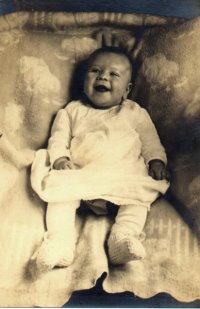
On Wednesday, December 21, 1927, Alice Tate Butler gave birth to a child fathered by Charlie Miles. Whether Alice's husband, Herman, believed the child to be his own or if he knew or even suspected that it wasn't is unknown. Nor is it known whether Charlie Miles knew the child to be his, or if he only suspected that it might be. In any event, apparently by mutual agreement, either spoken or unspoken, Charlie and Alice decided to let their friends, family, and neighbors believe that the baby boy to which Alice had just given birth was her husband's and consequently, he was named Raymond Joe Butler, taking the surname of the man--Herman H. Butler--who in effect adopted the boy as his own, even if he did not do so knowingly. (See photo of Raymond at age 3 months, below.)
Following the birth of Raymond, the Miles family continued to live at 1426 Rowan Avenue for two more years, leading one to wonder if during all that time Charlie ever had any interaction of any kind with his new son. Surely, he saw the boy from time-to-time, and when he did, one cannot help but wondering, did he feel any guilt, any shame, or any fatherly feelings? On the other side of the fence, so to speak, did Herman Butler ever suspect that little Raymond was not his? If so, there is no evidence, anecdotal or otherwise, that he ever treated the boy any differently from his other children. This suggests he believed the child was his. A classified advertisement in the November 10, 1929 issue of the Dallas Morning News, advertising 1426 Rowan Avenue as vacant and available to rent confirms that by that date, or soon after, Charlie Miles and his family moved to 5218 Garland Avenue (only a mile northeast of Rowan Avenue), where they lived in a modest frame house that is still standing. In December 1933 or January 1934, they moved again, this time to an eight-room cottage at 702 First Avenue (no longer standing), about a mile-and-a-half west of Rowan Avenue, for which they initially paid a rent of $25 per month (see classified ad, Dallas Morning News, December 19, 1933). Four years later, in October or November 1937, they moved a mile-and-a-half in the other direction to a reconditioned five-room cottage with two-car garage at 711 Wayne Street (still standing), in the Mount Auburn neighborhood, where they remained only two years (see classified ad in October 3 & 4, 1937 issue of the Dallas Morning News). From 1940 or '41 to 1944 or '45, the Charlie Miles family resided at 5605 Worth Street, in another East Dallas house that is still standing today in Junius Heights, about two miles north of their previous residence on Rowan Avenue. It is interesting to note that from 1927 to 1944, while Raymond Butler was growing up on Rowan Avenue, his real father never lived more than two miles away. It was only after Raymond was out of high school, or nearly so, that Charlie Miles and his family moved to a more distant address, 2311 Burbank Street (no longer standing), only a few blocks west of Love Field Airport, but eleven miles north of East Dallas. Whether this was deliberate or merely coincidental is unknown. The last house in which Charlie and his wife Lillian resided was one they purchased on September 17, 1945, from a widow named Mary Hunter, for $1,200. It was a modest one-story frame house with a two-car garage located at 9809 Denton Road, just a few blocks north of Bachman Lake, in an addition known as Maple Road Acres.
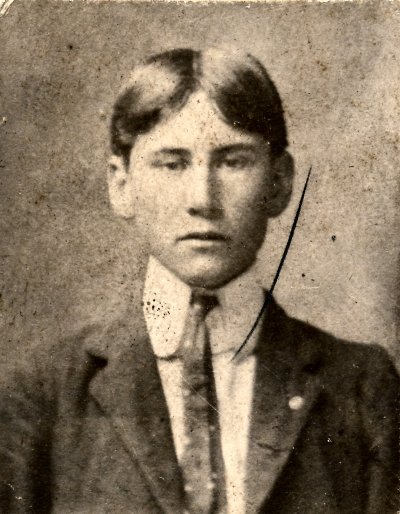
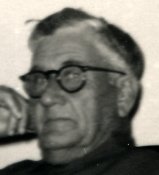
PHYSICAL APPEARANCE, TRAITS, and OTHER PERSONAL DATA Charlie's World War I draft registration card, dated September 12, 1918, describes him as tall, which is verified by photographs, and slender, with blue eyes and brown hair. Photographs taken after 1918 show that when he reached middle age, he started to become heavier, but not fat. His hair did not begin to lighten until he reached his sixties. Because he worked outdoors almost all his life, his face and hands were darkly tanned. Photos taken in the 1950s show him wearing eyeglasses, which are not seen in earlier photos.
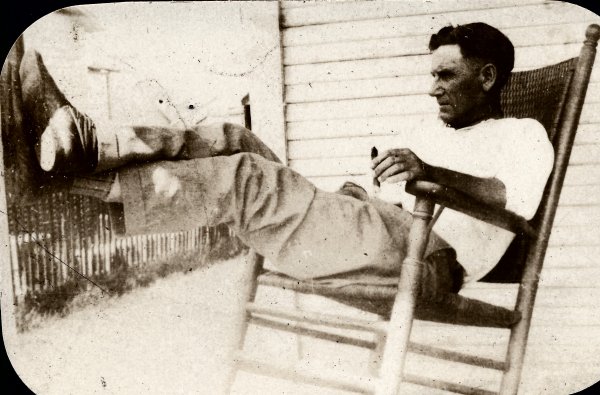
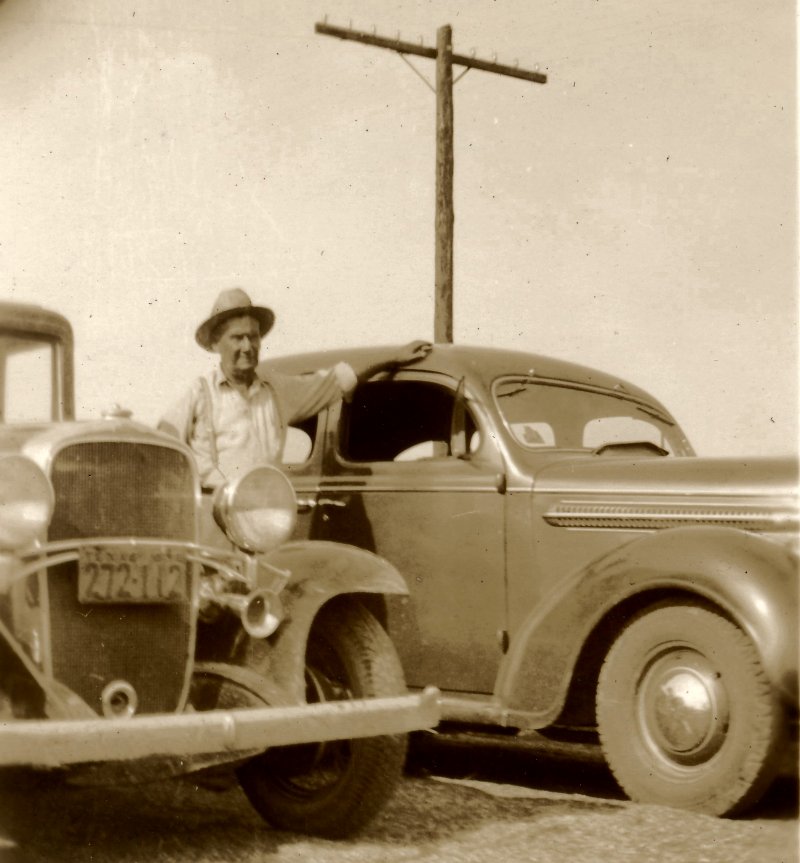
Photographs show Charlie smoking both cigarettes and cigars. There are several photos that show him sitting and relaxing, while having a smoke, in a rocking chair on the front porch of whatever house he happened to be living in at the time. When outdoors, he wore a hat with a brim. One photograph suggests that he liked to play dominoes. It is not known if he was much of a drinker or belonged to any fraternal organizations, or if he was particularly religious. Charlie never served in the military. He was too young for the Spanish-American War (only 13) and too old for World War One (age 33), and therefore also too old for the Second World War. A photograph taken in the 1920s suggests that he owned a Ford Model T. Another photo suggests that he owned either a 1937 Plymouth sedan with what were called "suicide doors" or a 1932 Chevrolet "Confederate." In the 1940s, he owned a black 1942 Ford Coupe (2 door), which can be seen in several family photos.
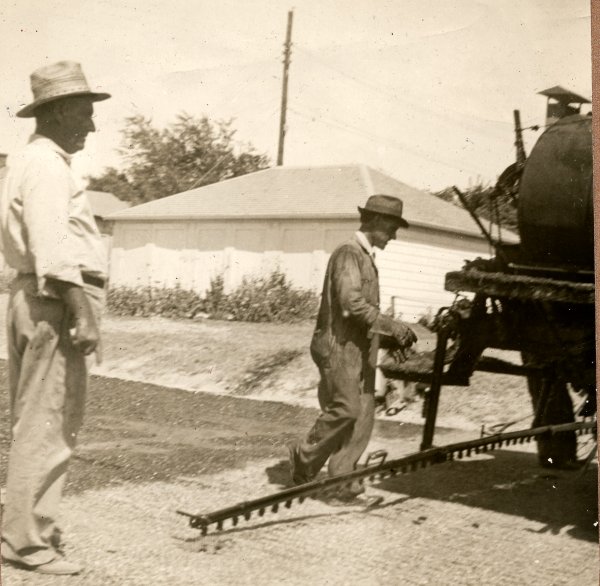
CHARLIE MILES, ROADBUILDER As previously noted, as a young man Charlie worked in a livery stable and as a farm hand. From about 1913 until he presumably retired in 1950 at the age of sixty-five, he worked for the Dallas County Road and Bridge District No. 1, first as an ordinary road laborer, and then, from about 1920 onward, as a road building crew supervisor or foreman. Throughout the 1920s, his boss was County Commissioner J. W. Slaughter, who during his term of office, hosted an annual celebration each September at the county shop in Farmers Branch, which Charlie and his family almost certainly attended. The fact that the county shop was located in Farmers Branch means that Charlie almost certainly had to commute to work from East Dallas by automobile since there were no streetcar lines that extended past the city limits. What sort of automobile(s) he owned is unknown, but during that period the Ford Model T was one of the most popular. In 1925, the Dallas Morning News reported that Road & Bridge District No. 1 received $260,310.86 during the year, of which it had a credit of $7,374.49 at the close of the year. In 1931, after Tom Field became Commissioner of Road and Bridge District One, the county shop was moved to a new location on Joe Field Road, in what was then unincorporated county land near Farmers Branch, between present-day Harry Hines Boulevard and Newkirk Street. At that time, the Dallas Morning News revealed that Commissioner Field was building five houses "for rent purposes," as well as a store building, "down where the new county shops have been located." The news speculated that a "little community will build up around this new county shop and works," and indeed it did (it was called "Field City"), but Charlie and his family never lived there, apparently preferring to reside in East Dallas. In 1937, when the Dallas Morning News reported the County Commissioner' Court budget for the coming year, among other things they noted that C. W. Miles had been reappointed "highway asphalt foreman at $187.50 a month."
Over the years, Charlie Miles was briefly mentioned in other reports in the Dallas Morning News, the Texas Mesquiter, the Carrollton Chronicle, and the Richardson Echo, in connection with his job as a road building crew foreman. During the 1940s, Charlie's boss was County Commissioner Lynn Lawther, with whom it appears Charlie made friends. On one occasion, when Lawther was running for reelection, Charlie personally paid for a political ad, urging people to vote for Lawther, that ran in the Dallas Morning News. HOW CHARLIE MILES BECAME A LAND-OWNER On August 29, 1922, Charlie’s father-in-law, Jim Dalton, who farmed and also owned a general store and gas station on what was then known as the Dallas-Richardson Pike (today’s Greenville Avenue) — at the spot where the road crosses White Rock Creek — entered into a contract with a man named T. B. (Tilden Barnes) Crosby to sell half of his 36-acre property, which he had purchased in 1897 from the Sanger brothers (Isaac, Philip, and Alex), owners of Dallas’ best-known department store. According to deed records on file in the Dallas County Records Building in downtown Dallas, Dalton’s fulfillment of the contract was dependent upon him being able to obtain a legally-recognized partition of his land(see Dallas County, Texas Deed Book 1183, pp.443-7), with half going jointly to his seven children, four of which were adults by January 1923, when his petition for partition was presented to a judge in the 14th District Court of Dallas County, after he had filed a civil suit with himself as plaintiff and his children as defendants, which superficially sounds like an adversarial thing to do, but from all appearances and intents and purposes was an entirely amicable affair (see Minutes of the 14th District Court, Dallas County, Texas, 1922-23, pp.609-612). On January 18, 1923, at the initial trial, which was more in the nature of a hearing because no jury was called by agreement of both Dalton and his children, the judge to whom the case (No. 44584) was assigned, approved Jim Dalton’s petition for partition, officially recognized his seven children as the lawful co-owners of half the property, and appointed three commissioners — C. B. Reddick, J. C. Carter, and W. V. Davis — to hire a surveyor and prepare a report as to precisely how the land should be divided (see Ibid). In the interim, Jim Dalton died (on March 23, 1923 (see Texas State Board of Health, Bureau of Vital Statistics, Standard Certificate of Death, Registered No. 126, James Franklin Dalton, March 26, 1923), and when the case (now designated No. 44585-A) was heard again on July 9, the judge approved the report that the three commissioners had filed on March 24, 1923, complete with a map of the property in question, showing how the land should be divided. The report also included a valuation, made by surveyor John R. West (who was awarded $25 for his services by the court), who reckoned the land was worth $300 per acre, or $10,800 for the entire property, which came to $5,400 per share (see Minutes of the 14th District Court, Dallas County, Texas, Book A, 1921-1931, pp.126-9). Share No. 1, ruled the judge, was Jim Dalton’s half, or rather, on account of his recent demise, the property of his estate, to be administered by one of his sons-in-law, L. C. McKamy, husband of Jim Dalton’s daughter, Maggie Dalton McKamy (see Ibid.) Share No. 2 was ruled to be the jointly owned property of Jim Dalton’s seven children, with each one receiving a one-seventh interest in the approximately 18-acre tract. These seven were: Charlie’s wife, Lillian Dalton Miles, Lillian’s sister, Maggie Dalton McKamy, their brother, Donald Roderick Dalton, their sister, Viola Dalton Busby, wife of John G. Busby, and Jim Dalton’s three minor children: Oneida, Gussie, and Winnie Ruby, with L. C. McKamy as guardian to protect their interests (appointed in February 1923). Previously, their court-appointed guardian was the Dalton children’s attorney, Albert S. Reagan, who afterward received $25 for his services in that regard. The three commissioners who prepared the report were awarded $9 each for three-days’ work (see Ibid). Following this hearing, L. C. McKamy, who had been court-ordered to fulfill the contract that Jim Dalton had made with T. B. (Tilden Barnes) Crosby, did so on March 30, 1925 (see Dallas County, Texas Deed Book 1183, pp.443-7). The following day, Crosby, who lived at nearby Vickery, sold the 18 acres of Share No. 1 to his younger brother Ira V. Crosby, who as a result became the new proprietor and operator of Jim Dalton’s former general store and gas station (see Dallas County, Texas Deed Book 1183, pp.442-3). Because Texas is a community property state, McKamy was co-owner of his wife Maggie’s one-seventh interest in Share No. 2, which explains why both were named as grantors when Maggie’s portion of Share No. 2 was sold to Ira V. Crosby on April 26, 1924 (see Dallas County, Texas Deed Book 1105, pp.79-80). So, by 1925, Ira V. Crosby was not only the owner of all of Share No. 1, but also part of Share 2, and this is where things get interesting. From all appearances, Ira V. Crosby was a rough sort of character, who had more than his share of bad luck, some of which it seems he brought upon himself by his own actions. For example, in 1921, The Richardson Echo reported:
A story in The Dallas Morning News with a few more details was similar. Although Ira Crosby was not expected to survive this gunshot wound, he did recover and as already pointed out, in 1923 became the proprietor of the Daltonville gas station and general store. Unfortunately, for Ira Crosby, the next three years would prove to be exceptionally unlucky for him. First, in 1924, he and his wife, Garvice, were divorced. The following year, on February 6, 1925, The Richardson Echo reported: “The store building, oil filling station, and stock of groceries belonging to Ira Crosby, known as the Daltonville store on White Rock Creek, located on the Richardson-Dallas Highway, was destroyed by fire on Saturday morning.” The Echo added that the loss was about $2,000, that Crosby had no insurance, and that he had already started to “rebuild his business” with lumber from Walton’s Lumber Yard in Richardson (see The Richardson Echo, Richardson, Texas, February 6, 1925). Then, in November of that same year, Crosby was in the news again when his “two story combination living quarters and summer business building at Kirkland Park [where Presbyterian Hospital stands today] burned,” leaving him with a loss of $1,500.” According to a report in the newspaper, the cause was unknown. (See ?) I don’t know if on New Year’s Day 1926, Ira V. Crosby recalled 1925 as a particularly unlucky year, but as it turned out, 1926 was worse, and whether or not he was responsible for the two fires that had destroyed his businesses, there is no doubt whatever that he brought what happened that November upon himself. Here, as described by The Richardson Echo, is what happened:
The story of the affray, as recalled in The Echo, left out a lot of details that were reported in The Dallas Morning News. According to The News, the soft drink stand where the incident happened was located on the road between Garland and Rowlett (present-day Centerville Road), near the Mills Cemetery. The News also said that Crosby, who drove his car to the stand, was accompanied by 18-year-old Douglas Scroggins of Vickery, who received a minor wound when a stray bullet [one of five shots fired] “grazed across the knuckles of his left hand.” (See Dallas Morning News, November 14, 1926). The two women, both of whom confessed to shooting Crosby, said The News, were Miss Juanita Overly, 21, and Mrs. Gladys Marie Redding, 23. In her statement to police, Overly said that when Crosby and Scroggins arrived, she and Mrs. Redding were inside the drink stand when Crosby arrived and “called to her to come out to him and that he was going to beat her to death.” When she refused, Crosby got out of his car and went into the stand and started beating her. When he knocked her to the floor, she managed to shoot him with “a .32 caliber automatic pistol” she carried “in a scabbard on her belt.” Mrs. Redding said she also shot Crosby to stop him hitting Overly. Then Scroggins, who received his wound while retreating from the stand, put Crosby’s dead body in the car and drove it to Garland, “where it was taken in charge by Cecil Williams, undertaker,” who found that Crosby “had a bullet hole through the back and another through the side.” (See Ibid.) When Garland police arrived on the scene, they immediately arrested both women on a charge of murder and took them to the county jail in downtown Dallas, where Overly was treated by a doctor for the bruises, and lacerations caused by Crosby, and both she and Redding gave statements. The following Monday, the two women were released from custody on a $2,500 bond for each. In December, after hearing their testimony and that of several witnesses, a grand jury refused to indict the two women. In the meantime, Crosby was laid to rest in the McCree Cemetery (also known as the Crosby Cemetery), on Audelia Road in Dallas. (See Dallas Morning News, November 16 & 17 and December 18, 1926). None of the news reports regarding this incident ever revealed how Crosby came to know Miss Overly or explained why he wanted to beat her. In all likelihood, it had something to with either sex or money, or maybe both. Following Crosby’s death, a Dallas County court appointed his ex-wife, Garvice Crosby, administratrix of his estate and gave her permission to sell his property in order to settle his debts. In 1929, she agreed to sell the 18 acres that her former husband had owned at Daltonville to her former brother-in-law, John D. Crosby, but the sale was cancelled when J. D. failed to come up with the money. (See Dallas County, Texas District Court Records 1928-1930, pp.54-5.) Instead, she sold all 18 acres of Share No. 1 to Constable William Guion of Richardson and in a separate transaction, she also sold him the one-seventh interest that her former husband had in Share No.2. (See Dallas County, Texas Deed Book 1624, pp.221-3 and Deed Book 1654, pp.470-1.) Ira Crosby, in tandem with his brother, T. B., also died owing $600 to J. F. Dalton’s heirs, a number which included Charlie Miles and wife, Lillian. Court records show that in 1930 they collectively brought suit against T. B. Crosby, since he was also a party to the debt, but the case was later dismissed.(See Dallas County, Texas District Court Records 1929-1931, pp.86-7 and pp.251-2.) So, as of the spring 1930, the joint owners of Share No. 2, or the bottom half of J. F. Dalton’s land, were Charlie Miles, his wife, Lillian, her sisters Viola, Oneida, Gussie, and Ruby, and William Guion, who also owned the entire 18 acres of Share No. 1, or the top half of the property. Presumably, all the owners benefited financially, throughout the remainder of the 1920s and into the 1930s and early 1940s, from renting the land, which was largely farmland, to whomever wished to raise crops thereon. Constable Guion, of course, also benefited from the general store and gas station which was located on the upper half of the former Dalton property. But wait! There’s more! William Guion died in 1931, and from all appearances, he willed the former Dalton property on White Rock Creek to his wife, Laura, including his one-seventh share of the bottom half of the site. Then, when Laura Guion died in 1937, she must have left that one-seventh share collectively to her daughter, Willie Mills, and also granddaughters Willie Wilkerson and Laura Mullen (see Dallas County, Texas District Court Minutes, October 1938, p.238), who were Laura Guion’s only living heirs, because when Charlie Miles, his wife, Lillian, and four of her sisters sold all of Share No. 2 or the bottom half of the property to Harry S. Moss, a wealthy petroleum company president, for $5,280 on August 4, 1943, Mills, Wilkerson, and Mullen were also all named in the deed as grantors. This means that every one-seventh owner (or owners) received $754.28 as compensation and since Charlie and his wife both owned one-seventh, they realized $1,508.56 from the sale — the equivalent of over $28,000 today (2026). At nearly the same time, Mills, Wilkerson, and Mullen sold the 18-acre Daltonville tract they had inherited from Laura Guion to Harry S. Moss for “Ten Dollars ($10.00) and other good and valuable considerations.” (See Dallas County, Texas Deed Book 2407, pp.287-8.) For decades, the entire 36-acre tract, which formerly belonged to the Sanger Brothers, then Jim Dalton, and then to almost all the other people mentioned in this section, including Charlie Miles, was part of Harry S. Moss’ “Moss Haven Farm,” where he kept horses and cattle on the largely undeveloped land. In 1972, following the death of Moss in 1970, a portion of his farm, including the Daltonville site, was donated by his heirs to the City of Dallas for use as a public park, which was named in honor of Moss. Today, the entire 36 acres that once belonged to Jim Dalton (and a portion to Charlie Miles) is a lighted soccer complex, on the south side of White Rock Creek, adjacent to Moss Park. (See Dallas Morning News, December 27, 1970 and March 21, 1972.) CHARLIE'S LAST YEARS
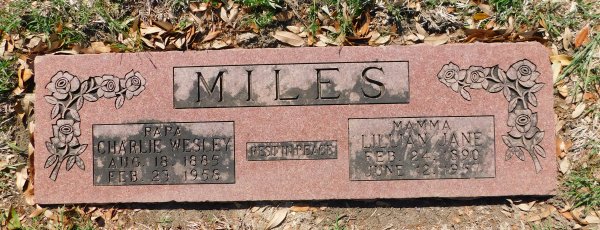
Photographs taken in the late 1940s and early-to-mid 1950s show Charlie and Lillian playing host to their adult children and their families, which by this time included cousins Kay Bailey (daughter of Lorene), Beverly Wright (daughter of Willie Mae), and Vernon Ray Miles (son of Roderick). Outside the house was a picnic table around which the family gathered on special occasions. On June 13, 1957, Lillian Miles died. The following day, her funeral was held at the Rhoton Funeral Chapel in Carrollton. She was afterward buried at Laurel Land Cemetery in Oak Cliff. Charlie did not live much longer himself. On Sunday, February 23, 1958, a little less than nine months after Lillian died, Charlie passed away at the age of seventy-two. His funeral service was likewise held at the Rhoton Funeral Chapel in Carrollton. It is not known whether it was by design or simply a coincidence, but the Rhoton Funeral Home was founded by Junius Tribble Rhoton, brother of Benjamin W. Rhoton, the man who had taken Charlie in as his "adopted son" in the 1890s in Franklin County, Tennessee. Following his funeral, which was held on Tuesday, February 25, 1958, Charlie was laid to rest beside Lillian at Laurel Land, the same cemetery where daughter Lorene and her husband Ed Bailey, and also son Roderick and his wife were later buried.
It is not known whether Charlie ever knew for certain that Raymond Joe Butler, the child he conceived with his next-door neighbor, Alice Tate Butler, in 1927, was his child, or if he merely suspected. It is likewise unknown if Charlie ever took any interest in Raymond, who grew to manhood with his actual father never living more than two miles away. It is not likely, however, that they had any contact. Up to the day he died (November 13, 2019), Raymond believed that Herman H. Butler (who died in 1935) was his birth father. Ironically, Raymond was living in Carrollton in 1958, when his real father's funeral was held there. Equally ironic is the fact that Raymond was buried next to Herman Butler, at Forest Lawn Cemetery. Not surprisingly, when his father's house on Denton Drive was sold by his half-brother and half-sisters, following Charlie Miles' death, Raymond got no part of the $15,000 they received for it. I do not know if my grandfather left a will, but if he did, it is unlikely that my father was mentioned in it. EPILOGUE My father, Raymond Joe Butler died on Wednesday, November 13, 2019, without ever knowing that Charlie Miles was his biological father. Owing to my father's age (91) at the time this family secret was uncovered, I thought it best to keep it from him, just as my grandmother had done, fearing that emotionally it would probably do him a lot more harm than good. Part of me wanted to tell him, because I felt it was his right to know the truth, but what good would it have done? Charlie was long dead and there was nothing that could be done to make up for the past. In short, there could be no happy ending, only remorse and regret. Therefore, under the circumstances, I feel that I did the right thing. It's just too bad that my grandmother did not tell her youngest son the truth when she had the chance, while he was still young enough to handle it and while his actual father was still alive. But if confronted, would Charlie have denied it? Or accepted my father as his own and made some attempt to make up for lost time? Sadly, we will never know. Certainly, there is no better example of the truth of a saying that I came up with a long time ago: "Sometimes it seems that the saddest things in life are not what actually happened, but rather the things that could have happened, but didn't."
This website copyright © 1996-2026 by Steven R. Butler, Ph.D. All rights reserved. |

 According to an "Early History of Richardson," published in The Richardson Echo in 1950, sometime during the first decade of the twentieth century, Charlie Miles operated a livery stable owned by Fred Farrell, which was located "on Central [street, not expressway] and West Main known as the onion dock owned by the Texas Electric Ry. where heavy freight was handled." According to the same article, "Mr. Farrell kept horses and buggies to rent and a place to keep stock when folks came to town and their horse or team while they went to Dallas or Plano by train." (See The Richardson Echo, March 3, 1950.) However, The Echo did not say how long Charlie held this job, and precisely when.

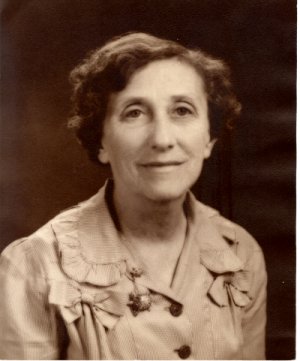 Sometime in March or early April 1927, owing to circumstances that are completely unknown to anyone living today, Charlie W. Miles and his neighbor, Alice Tate Butler (see photo, left), both forty-one-years-old, had a secret, intimate liaison that resulted in Alice becoming pregnant. Whether their relationship took the form of a "one-night stand" or a long-term "love affair" is unknown. Nor is it known whether either of their spouses knew of the affair or liaison.
 It's easy to understand why Charlie and Alice chose to keep Raymond's paternity a secret. To reveal it would almost certainly have resulted in two divorces and two broken families. It would have also subjected both parties, as well as their child, to the scorn of disapproving family, friends, and neighbors. For Alice, owing to the double standard that then prevailed, the shame and disgrace would almost certainly have been unbearable. Without a husband, she would have been forced to raise Raymond on her own, and without any marketable skills of any kind, the only kind of work she would likely be able to find would have been low-paid and menial.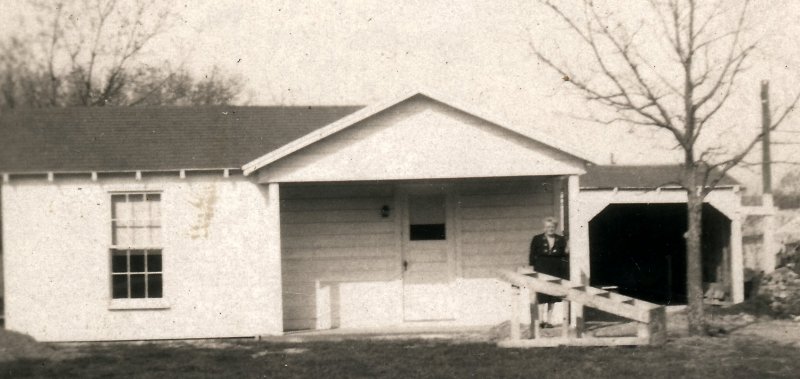
 In all likelihood, Charlie Miles retired in 1950, when he turned sixty-five and was eligible to draw social security and possibly also a county pension.