
|
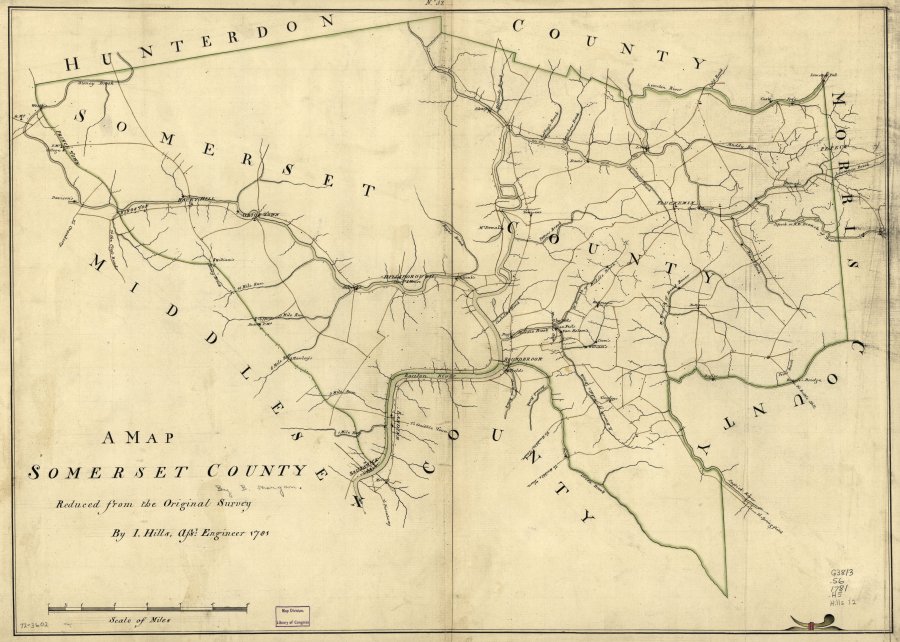
Van Meter Family JAN OR JOHN VAN METER (1683-1745) Jan or "John" Van Meter was born in 1683, the eldest son of Jooste Jans Van Meteren and his wife Sarah Du Bois, apparently at Kingston, Ulster County, New York.1 At some point in his life he Anglicized his given name to John and dropped the "n" from his family name. It's possible that his father may have done the same before his death sometime during the first decade of the eighteenth century. Presently, we do not know for sure where John Van Meter spent his childhood. Although he was born in New York's Hudson River Valley, his parents may have afterwards removed to Somerset County, New Jersey, where John's grandfather first acquired a tract of land in the year 1695.2 About 1705, according to one source, John (a.k.a. Jan Joosten) Van Meter "is supposed to have married…Sarah Bodine (or Berdine, according to traditions), probably the daughter of Peter or Isaac Bodine, who came to that locality in the trend of settlement up the Raritan Valley to Staten Island, N. Y., where a number of French Huguenots had settled many years before." According to this same source, John (or Jan Joosten) Van Meter and his wife Sarah had three children who were baptized in the Dutch Reformed Church at Somerville, New Jersey: Sara, on 30 October 1706; Johannes, on 28 April 1708; and Maria, on 26 April 1709." Their mother is supposed to have died in 1709.3 In 1710, at the age of twenty-seven, John Van Meter married his cousin Margreit or Margaret Mulliner, who is said to have been the daughter of John's uncle Henderick (or Henry) Mulliner and his wife Catherin or Cathelina Crom Van Meteren (who was the older sister of Jooste Jans Van Meteren).4 Although Henry Mulliner's will, dated January 3, 1712 in Somerset County, New Jersey, names Jooste Jans' three sons -- Isaac, John, and Henry (Hendrick), as administrators of his estate, it does not name Margreit as an heir.5 The only possible explanation, if she was indeed his daughter, was that being recently married, perhaps she had already received her share of the estate as a wedding dowry.
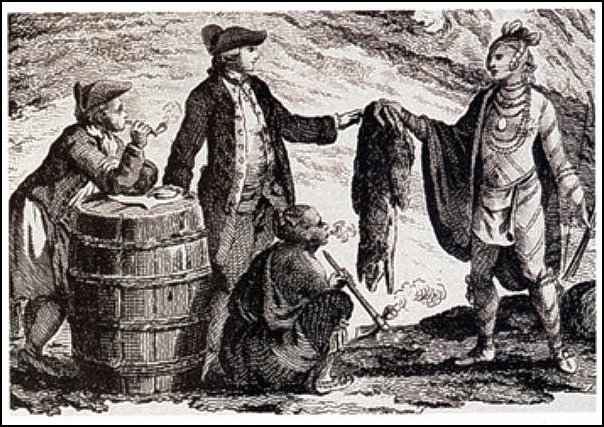
In 1714 John Van Meter, along with his brother Isaac, mother Sarah Du Bois, and uncle Jacob Du Bois, also bought land in New Jersey -- 3,000 acres located in Salem County. Two years later John and Isaac, along with their mother Sarah, sold their shares to their uncle Jacob. One writer has speculated that John Van Meter and his mother returned to New York at this time while Isaac stayed on in New Jersey. Indeed, it was in Salem County, New Jersey, about 1717, that Isaac Van Meter married Annetje Wynkoop, daughter of Gerritt and Helena Wynkoop of Moreland Township, Pennsylvania.6 It has been written that John Van Meter's son Jacob was born in Somerset County, New Jersey. Thus, we may assume it was there that John and Margreit Van Meter made their home during the early years of their marriage. Together, this couple had at least ten children. They were (but not necessarily in this order): Abraham; Isaac; Jacob (born March 17, 1722/23); Johanes; Sarah (who later married James Davis); Mary (who later married Robert Jones); Rebecca (who later married Thomas Hedges); Elizabeth (who later married Thomas Shepherd); Rachel (who later married a man named Lefarge); and Magdalene.7 John Van Meter made his living, at least for a while, trading with the Delaware Indians in the mountainous regions of western Virginia. On one occasion, his friendship with this tribe nearly cost him his life. A little more than a century later, historian Samuel Kercheval wrote about the incident in his book, History of the Valley of Virginia:
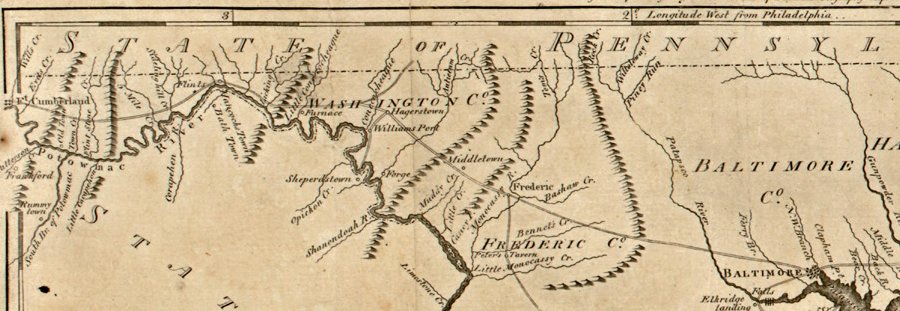
Another account, related by a Van Meter descendant in 1898, holds that only John Van Meter and two Delaware Indians survived this battle.9 Samuel Kercheval tells us that after John Van Meter "returned to New York, he advised his sons, that if they ever migrated to Virginia, by all means to secure a part of the South Branch [of the Potomac] bottom, and described the lands immediately above what is called "The Trough," as the finest body of land which he had ever discovered in all his travels."10 Although John Van Meter and his sons did in fact later settle in western Virginia, they removed first to Maryland. One writer tells us that on November 3, 1726, Van Meter received a grant of 200 acres of land from Lord Baltimore, "which he located at or near what is now Monacacy Junction, near Frederick, Maryland.11 This statement is corroborated, more or less, by the land records of the Colony of Maryland which show that in 1724 one John Vanmetre acquired a 300 acre tract called "Metre" in Prince George's County, Maryland and that furthermore, on November 8, 1726, he acquired an additional 150 acre tract called "The Meadow" in the same county. Although I haven't been able to ascertain whether these tracts were near the town of Frederick, when John Van Meter later sold this property, the deed included the notation that it was located on the Monacacy River.12
Two of John Van Meter's sons also purchased or were granted property in Prince George's County, Maryland. Two deeds, both dated October 1732, about the time that the boys would have reached their majority, reveal that Isaac Van Meter became the owner of a 200 acre tract called "Isaac's Inheritance," and Johanes Van Meter took possession of a 200 acre tract called "Ripe Meadows."13 It may have been that John Van Meter first began his explorations of the Virginia wilderness while living in nearby Maryland. In all likelihood, he made at least a few of his trips in the company of his brother Isaac and perhaps also his brother Henry.
Isaac Van Meter's proposal to the Governor and Council of the Colony of Virginia was similar to his brother's except that it identified Isaac as a resident of "the Province of West Jersey." which he was, apparently, at that time. It also included the comment that "the petitioner has been to view the lands in those parts," which provides us with proof that both Isaac and John had previously explored the terrain, probably together. One curious difference between the two petitions was that Isaac's mentions "divers German families" that he wished to settle on his grant.15 Both petitions were approved on June 17, 1730.16 Within four years after choosing the best lands for themselves and their families, John and Isaac Van Meter sold most of their Virginia property to a New Jersey relative, Jost Hite, who is credited with being the principal colonizer of the upper Shenandoah Valley. Apparently, Hite was for many years also erroneously credited with being the very first pioneer settler in the area and the first white man to cross the Potomac west of the Blue Ridge mountains, distinctions that more rightly belong to John and Isaac Van Meter. In his 1908 book, Shenadoah Valley Pioneers, historian T. K. Cartmell, sought to set the record straight. In doing so, he had this to say about the Van Meter brothers:
As to the question of whether Hite had been the white first man to enter the region by crossing the Potomac, Cartmell added:
When John Van Meter brought his family from Maryland to live in the upper portion of the Shenandoah Valley about 1731, the area in which they settled, now part of the State of West Virginia, was an unspoiled wilderness. In those days, the Shenandoah Valley, was called the "Great Valley of Virginia." On August 5, 1741, about ten years after John Van Meter had removed his family to Virginia, he sold his land called "Metere, lying upon Menockecy River…and containing 300 acres" in Prince George's County, Maryland in two tracts (one of 138 acres and one of 162 acres) to Joseph and Thomas Palmer of Westchester County, New York. The total price the Palmer brother paid was £293.19 On the 30th of that same month, John's eighteen-year-old son Jacob Van Meter was married to sixteen-year-old Letitia Strode.20 There is also a record, in the Pennsylvania Gazette, of Isaac Van Meter advertising two tracts of land for sale in February 1743. One, consisting of 400 acres, was located in Salem County, New Jersey, "being about seven miles from Salem." A second 400-acre tract, "near Alloway's Creek" in Salem County, consisted of 100 acres of cleared land, 100 apple trees "good fruit," "good Wheatland, and good Meadow Ground, well-watered and timbered for Fencing." Van Meter also posted a notice in the Gazette "that on Account of Purchase of a certain Tract of Land, scituate on the South Bank of Potomack, bought from James Ross, the Subscriber hereof given Obligation for the Sum of Twenty-Eight Pounds payable in May next; These are to desire that an Assignment of said Obligation may not be taken by any Person, unless they will stand a Suit of Law for the same, he the said Ross not being able to make any Title for said Land."21 Our final record of John Van Meter is his will, signed and dated August 13, 1745, and proven in court in Frederick County, Virginia on September 3, 1745. To his son Abraham, he left 350 acres of land. He also left tracts of land to sons Isaac and Jacob, daughter Sarah (wife of James Davis), daughter Rebecca (wife of Thomas Hedges), daughter Elizabeth (wife of Thomas Shepherd), daughter Magdalene, and grandson John Lefarge (son of John's deceased daughter Rachel). To his grandson Johannes Van Meter (son of John's deceased son Johanes) and granddaughter Joanna Van Meter (daughter of the deceased Johanes), he left £15 to be paid when they reached the age of twenty-one. To daughter Mary, the wife of Robert Jones, he left the 350 acre tract of land where he had been living at the time of his death. Apparently, his wife Margreit was still alive at the time of his death because he also stipulated that after her decease, their daughter Mary was to also have one-third of "moveable estate," meaning perhaps livestock or furniture (or both).22 Unfortunately, we do not know when Margreit Van Meter died nor do we know where she and her husband were buried. NOTES 3Samuel Gordon Smyth, ed., A Genealogy of the Duke-Shepherd-Van Metre Family... (Lancaster, Pennsylvania: The New Era Printing Company, 1909), 16. 4I obtained this information from the LDS Family Search website (www.familysearch.org). I believe it is probably true but I have not looked for any supporting evidence. 5William Nelson, ed., Archives of the State of New Jersey, First Series, vol. xxiii, vol. I 1670-1730 (Paterson, New Jersey: The Press Printing and Publishing Company, 1901), 332. 6Genealogies of West Virginia Families (Baltimore: Genealogical Publishing Company for Clearfield Company, 1997), 257-258. 8Samuel Kercheval, History of the Valley of Virginia (Winchester, Virginia: Samuel H. Davis, 1833), 72. 9Genealogies of West Virginia Families, 245. 10Kercheval, 72. 11T. K. Cartmell, Shenandoah Valley Pioneers and Their Descendants: A History of Frederick County, Virginia (1908; reprinted 1963), 12. 12Peter Wilson Coldham, Settlers of Maryland, 1701-1730 (Baltimore: Genealogical Publishing Co., 1996), 160 & 230. 13Ibid., 230. 14Cartmell, 13. The original, of course, is in the Virginia State Library and Archives. 15Ibid. 16Ibid. 17Ibid. 18Ibid., 13-14. 20I obtained this date from the LDS Family Search website (www.familysearch.org) but printed sources confirm the year and place, if not the actual date. One such source is Howard L. Lecky's The Tenmile Country and Its Pioneer Families (Apollo, Pennsylvania: Closson Press, 1993). This marriage is said to have taken place in Frederick County, Virginia, which was formed out of Orange County in the 1700s, but I have not been able to find a record of it in the Frederick County court records. It may be that the change had not yet taken place. In John Van Meter's deed of sale to the Palmer brothers, dated only a few weeks prior to his son's marriage, he is identified as "John Vanmatre of Orange County, Virginia, yeoman." It may be that the record is in the Orange County courthouse instead. 21The Pennsylvania Gazette, Philadelphia, Pennsylvania, issue 740, page 4. 22J. Estelle King, Abstracts of Wills, Inventories and Administration Accounts of Frederick County, Virginia, 1743-1800 (Baltimore: Genealogical Publishing Company, 1980), 2.
Van Meter Family
This website copyright © 1996-2016 by Steven R. Butler, Ph.D. All rights reserved. |

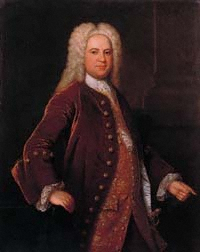 Whether the story about John Van Meter's close escape from being killed by Indians is fact or fiction, it is certainly true that in 1730 he and his brother Isaac personally visited the Royal Governor of Virginia, William Gooch (see picture, left), at Williamsburg, which was then the capital of the colony. Their purpose: To petition the governor for a grant of land in the vicinity of the south branch of the Potomac. The following is from the original journal of the Governor and Council of Virginia, session 1721-1734: